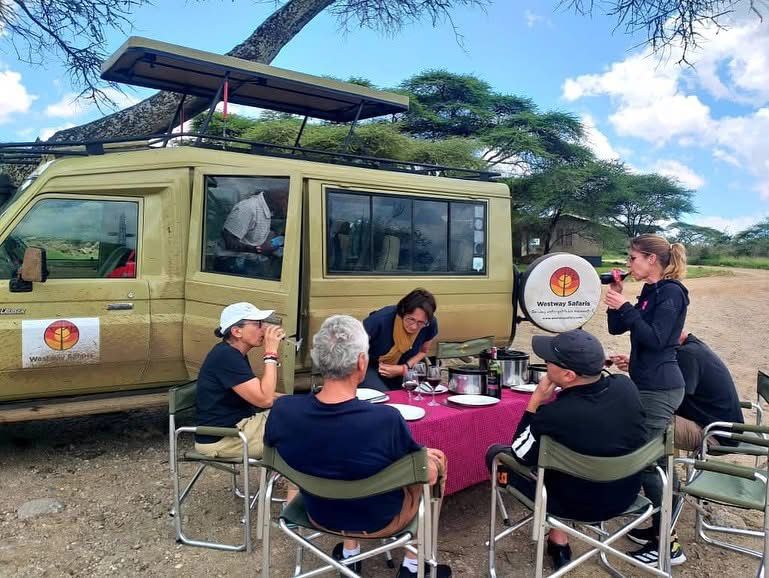
The largest bookings I handle every year are not the luxury couples in the finest Serengeti camps, or the honeymoon pairs spending two weeks across Tanzania and Zanzibar. The largest bookings, in terms of total value and logistical complexity, are the group safaris: extended families celebrating a 70th birthday, friend groups of twelve who have been planning this trip for three years, corporate retreats that need to hold together a mix of executives and junior staff who all have different ideas of what a safari should look like. These bookings are different in almost every dimension from a private couple safari. The mistake most operators make is treating them the same.
I have planned group safaris ranging from 6 people sharing two vehicles to 22 people requiring a full private camp buyout. In this guide I will tell you exactly what changes when a group reaches that size, what the logistics actually look like, what the costs do, and how to structure an experience that everyone in the group genuinely enjoys rather than tolerates. This is the practical guide that most operators skip.
Why Large Groups Need Different Planning
A couple on safari has one decision-maker or two who are already aligned. They agree on wake-up time, on pace, on whether to stay with a cheetah sighting for ninety minutes or move on after thirty. A group of fourteen people has fourteen perspectives on all of those questions, and the likelihood that they are naturally aligned on everything is close to zero.
There is also the physical reality of movement. A couple in one vehicle can respond to a sighting in seconds. Three vehicles carrying fourteen people need to communicate, reposition, and navigate without blocking each other's sightlines. The gap between a well-coordinated multi-vehicle group and a poorly managed one is the difference between an extraordinary shared experience and a frustrating logistical exercise that the wildlife happens to be present for.
The differences that matter most in practice are: vehicle allocation, inter-vehicle communication, accommodation structure, itinerary flexibility for different energy levels and interests within the group, dietary management across a large party, and how milestone moments are handled. I will take each of these in sequence.
Vehicle Allocation: The Foundation of Everything
A standard Toyota Land Cruiser 4x4, which is the vehicle used on virtually all Tanzania safaris, seats a maximum of 6 passengers in its game-viewing configuration. Every seat has access to the pop-up roof hatch. Every passenger can, in theory, see out of the vehicle and photograph from it.
In practice, 4 passengers per vehicle is the quality standard for a serious safari. With 4 people in a Land Cruiser, every guest has a dedicated window seat, a full unobstructed roof hatch position, and enough room to swing a telephoto lens without making contact with the person next to them. With 6 people in the same vehicle, two guests are always in the middle position on each row. Photography is compromised. Personal space disappears. After seven hours of game drives across rough terrain, six people in a Land Cruiser is fatiguing in a way that four people is not.
My standard recommendation for group safaris is to allocate vehicles on a 4-per-vehicle basis and adjust the vehicle count upward accordingly. This costs more in vehicle hire and additional guide salaries, but it is the single most significant quality lever available on a group safari. A group that books 12 people into 2 vehicles (6 each) and a group that books 12 people into 3 vehicles (4 each) are having fundamentally different safaris.
For the practical calculation: a group of 6 people uses 1 to 2 vehicles depending on budget and preference. A group of 8 uses 2 vehicles. A group of 12 uses 3 vehicles. A group of 16 to 20 uses 4 to 5 vehicles. Beyond 20 people, the convoy starts to create its own logistical challenges at park gates and camp arrivals, and I generally recommend splitting very large groups into two sub-groups with slightly different schedules when the headcount exceeds 20.
The Cost Advantage of a Larger Group
Here is the financial reality of group safaris that most operators under-explain: per-person cost drops meaningfully as a group grows, because the fixed costs of the safari (vehicle hire, guide salary, fuel) are divided across more people. Park fees, accommodation, and international flights remain entirely per-person, but the vehicle and guide costs, which represent a significant portion of a safari budget, dilute as headcount increases.
The table below shows approximate per-person costs for a 7-day northern circuit Tanzania safari at a mid-range to semi-luxury level, excluding international flights. These are ranges that reflect real variability in accommodation tier and season.
| Group Size | Vehicles Required | Per-Person Cost Range (7 days) | Notes |
|---|---|---|---|
| 2 people | 1 vehicle | $4,000 to $7,000 pp | Full vehicle cost shared by 2 |
| 4 people | 1 vehicle | $3,000 to $5,500 pp | Optimal fill per vehicle |
| 6 people | 1 to 2 vehicles | $2,600 to $4,800 pp | Comfort improves with 2 vehicles |
| 8 people | 2 vehicles | $2,300 to $4,200 pp | 4 per vehicle, strong value |
| 12 people | 3 vehicles | $2,100 to $3,800 pp | Vehicle cost well diluted |
| 16 people | 4 vehicles | $1,900 to $3,400 pp | Best per-person value range |
| 20 people | 5 vehicles | $1,800 to $3,200 pp | Consider private camp buyout |
The practical takeaway is that a group of 16 people can access a significantly better quality experience at the same per-person budget as a couple, because the per-person vehicle cost at 16 is roughly a quarter of what it is at 2. A full breakdown of how Tanzania safari costs are structured explains the component parts in more detail, including where the large fixed costs sit and which line items scale with headcount.
Communication Between Vehicles
Three Land Cruisers spread across the Serengeti need a reliable way to share information in real time. When the lead vehicle finds a leopard in a tree half a kilometre off the track, the other two guides need to know location, approach direction, and whether the animal is stationary or moving. The communication system between guides is what determines whether a sighting becomes a shared group experience or something only the front vehicle sees clearly.
Professional guides operating as a team use VHF radio as the primary inter-vehicle channel. Every vehicle has a set. Guides call sightings, relay GPS coordinates for specific locations, and coordinate convoy positioning before arriving at gates or camps. This is non-negotiable for a well-run multi-vehicle group safari, and I confirm radio equipment on every vehicle before any group departs.
Beyond radio, we establish a group WhatsApp channel before the safari begins. This is for the clients as much as for the guides. Group members across different vehicles can share real-time photographs, coordinate which vehicle is approaching a sighting, and communicate preferences to their guide directly. It also allows the lead guide to send the group a morning briefing and the day's plan before breakfast, so everyone knows the schedule regardless of which vehicle they are in.
Convoy driving in national parks requires some discipline from the guides. Vehicles should not bunch too closely, as this creates a wall of metal that disrupts sightings and blocks other guests. We position vehicles at angles around predator sightings so that each vehicle has a different perspective. A lion pride with one vehicle parked directly in front is a confined photograph; the same sighting with three vehicles at staggered angles produces three different, better images for every guest.
Accommodation: Rooms, Wings, and Full Buyouts
A group of 8 people can usually be accommodated at any mid-range or luxury camp by booking all or most of their available rooms without displacing other guests significantly. A group of 16 to 20 people starts to involve a different conversation: whether to book individual rooms across two or three properties, or to execute a private camp buyout at a single property.
A private camp buyout means your group occupies the entire camp for the duration of your stay. All staff work exclusively for your group. The chef designs meals around your group's preferences and dietary requirements. Game drives run on your schedule, not a camp-wide schedule. Bush dinners and celebration events are arranged as your group sees fit, not as add-ons competing with other guests. The experience of a buyout is categorically different from sharing a camp, and for milestone celebrations specifically, it is the version I almost always recommend when the budget allows.
Most private camps and tented properties in the Serengeti and Ngorongoro have between 8 and 16 units. A full buyout for a 12-person group means taking all 12 available rooms. For a 20-person group, either a larger property is required or the group occupies two smaller properties in the same area simultaneously, with vehicles ferrying between them for shared activities. Both structures work; the two-property version requires more logistical coordination but gives the group a broader accommodation experience.
Pricing for buyouts is typically quoted as a flat property rate rather than a per-room rate, which in practice means that a group of 16 filling a 16-room camp pays less per person than a group of 10 filling the same camp at the same flat rate. Buyout rates also frequently include room for negotiation that standard room bookings do not, particularly for shoulder season travel.
If you have a group forming and want to know what a buyout would actually cost for your dates and headcount, send the details on WhatsApp and I will come back with real numbers within 24 hours.
Itinerary Flexibility: Not Everyone Wakes at 5:30am
This is the detail that causes more friction on group safaris than any other, and it is almost never discussed in the booking process. A group of 14 people will contain early risers who want to be in the vehicle at first light and people who are on holiday and have no intention of seeing 6am. It will contain keen walkers and people whose knees cannot handle a multi-hour bush walk. It will contain photography enthusiasts who want to sit with a single sighting for ninety minutes and people who want to keep moving and see as much variety as possible.
The solution is not to force the group onto a single itinerary. The solution is to design a structure that allows sub-groups to split without losing the group experience.
In practice, this means: early-drive guests depart at first light in one or two vehicles, while late risers take a later departure in the remaining vehicle. The early group returns for a proper breakfast and the late group departs as they finish eating. Both groups share the same camp and the same evening, and the midday downtime brings everyone together for the meal and the siesta that every good safari day should have. At the end of the day, every vehicle reunites for the sundowner, which is the moment that works best as a shared group experience.
A multi-vehicle group can also offer different game drive focuses within the same park. While one vehicle works a productive lion territory in the northern Serengeti, another can focus on the river crossing points for guests who are most interested in migration sightings. The guides communicate throughout the morning and vehicles converge when something genuinely worth sharing is found.
For groups with a wide age range, including older guests or young children, I build the itinerary with a rest day or a half-day option on the third or fourth day. By day four of a Tanzania safari, even the most energetic guests often welcome a morning at camp before returning for the afternoon drive. Planning this in advance, rather than improvising when someone is tired, prevents the dynamic where one person feels they are holding the group back.
Meals and Dietary Requirements
A group of 14 people will almost certainly include vegetarians, someone avoiding gluten, someone with a nut allergy, someone observing halal dietary practice, and at least one person who will cheerfully eat anything. Most good safari camps manage dietary requirements competently for small groups. For large groups, the communication of requirements to camp kitchens requires more structure.
Before any group departs, I collect a complete dietary requirement list from the group organiser and send it to every camp on the itinerary at least three weeks in advance, with a follow-up confirmation one week before arrival. Bush dinner menus and special celebration meals are discussed with the camps at least two weeks out. Assumptions about dietary requirements are not made; every requirement is written, confirmed, and re-confirmed.
For private camp buyouts, the group has effectively hired the kitchen. The chef can be briefed directly by the group organiser or by a designated point of contact within the group, and menus can be adapted to the group's preferences in a way that is not possible at a shared camp. This is one of the underrated advantages of a buyout for large groups with diverse dietary needs.
Milestone Celebrations on Safari
A significant proportion of the large group bookings I handle are built around a specific occasion. A 60th birthday. A 40th wedding anniversary. A family reunion that has been planned across three continents. A corporate milestone. The safari is not incidental to the occasion. The occasion is part of the safari's purpose, and planning for it needs to be explicit from the start.

The events that work best on large group safaris, based on what I have seen land well across many bookings, are the following. A bush dinner at sunset, set up by camp staff in a clearing away from the main camp buildings, with a long table, lanterns, and an open sky, is the defining group moment of most safaris I plan. It requires advance notice to the camp and usually carries a small per-person surcharge, but it is the moment that photographs and the moment that guests remember longest. A sundowner stop during the afternoon game drive, where vehicles park on an elevated point and drinks are served while the light changes, is lower-cost and works even without a buyout at any camp willing to arrange it. A birthday cake delivered to the vehicle during a morning drive, or brought out at dinner, requires nothing more than advance communication with the camp kitchen. Many camps also offer cultural experiences, Maasai ceremonies, or storytelling evenings with local guides, that can be dedicated to a group's occasion rather than offered as generic camp activities.
The important thing is to communicate the occasion at booking stage, not as an afterthought. A camp told six months in advance that a group is celebrating a 70th birthday will design around it. A camp told on arrival will do what it can, which is not the same thing.
Deposit and Payment Logistics for Groups
Groups introduce a payment complexity that individual bookings do not have. Who pays the deposit? Does each guest pay their own share directly, or does a group organiser collect and pay centrally? What happens if one person in the group withdraws after the non-refundable deposit period?
My standard approach for group bookings is to work with one designated group organiser as the single point of contact and financial counterpart. The organiser manages internal payment collection within the group. We issue one invoice and one payment schedule to the organiser, not 14 separate invoices to 14 individuals. This simplifies the operator side substantially and places the internal group coordination where it belongs: within the group itself.
The deposit structure for group bookings is typically 30 percent on confirmation to secure accommodation and vehicles, with the balance due 60 to 90 days before departure. For private camp buyouts, properties sometimes require a higher initial deposit, as the commitment to hold the entire property off the market is significant. All deposit terms and cancellation conditions are confirmed in writing before any payment is made.
For groups where individual payment is preferred, some group organisers use shared payment platforms to collect contributions internally before paying us centrally. How the group organises itself internally is entirely outside our scope; what matters on our end is that one payment arrives at each milestone, from one source, in the agreed currency. If you are planning a group where cost-sharing is complex, I recommend resolving that structure within the group before booking, as internal payment disputes have a way of affecting the smoothness of the booking and, occasionally, the departure itself.
On the subject of booking lead time: as I noted in the FAQ section below, groups of 12 or more should be aiming for 9 to 12 months of lead time. If you are reading this and your group is forming now, the time to make contact is now. The properties and vehicles that make a group safari genuinely excellent are not held available until the last moment. A full guide to booking timeline and planning sequence covers this in more detail, and it applies to group bookings at least as much as it does to individual ones.
Private vs. Shared Group Safaris
I want to be precise about what "private" means in the context of group safaris, because the term is used loosely. A private group safari means all vehicles, guides, and game drive schedules are dedicated entirely to your group. You do not join vehicles with strangers. You do not follow a camp-wide game drive schedule. Your itinerary is built entirely around your group's preferences and occasion. Every group safari I plan for groups of 6 or more is private in this sense.
This is a different question from whether your accommodation is shared or bought out. It is entirely possible to have a private group safari, all vehicles dedicated, itinerary fully custom, with accommodation shared at a camp where other guests are also staying. The vehicles are yours; the dining room may also contain other people. Many groups are entirely comfortable with this. A detailed comparison of private and group safari structures covers the distinction clearly if you want to think through which version matches your group's expectations.
Frequently Asked Questions
Per-person cost on a 7-day mid-range northern circuit safari drops significantly as group size increases because vehicle and guide costs are shared. A couple typically pays $3,500 to $6,000 per person. A group of 8 sharing two vehicles might pay $2,300 to $4,000 per person. A group of 16 sharing three vehicles can reach $1,900 to $3,400 per person. The larger the group, the more the fixed vehicle and guide costs are diluted across more people. Park fees, accommodation, and flights remain per-person regardless of group size.
A standard Toyota Land Cruiser has a legal maximum of 6 passengers in the game-viewing configuration. In practice, 4 passengers per vehicle is the comfortable standard for a quality safari. With 4 people, every guest has a window seat, a full roof hatch position, and room to move and photograph without crowding. Six people in one vehicle works, but photography and comfort are noticeably compromised. For groups, I always recommend building the vehicle allocation around 4 per vehicle rather than 6, and adjusting total vehicle count accordingly.
Yes. A private group safari means all vehicles are dedicated to your group, your guide team works exclusively for you, and your itinerary is set entirely around your group's preferences. There is no joining a shared vehicle or shared game drive schedule. For groups of 12 or more, a private camp buyout is also possible at certain properties, which means your group has the entire camp to yourselves, including all staff, a dedicated chef, and the full camp infrastructure. Private camp buyouts are most common with groups of 12 to 20 people and typically require booking 9 to 12 months in advance.
For groups of 6 to 10 people, a 6-month lead time is a reasonable minimum for travel in any season. For groups of 12 or more, or for travel during the peak months of July and August, 9 to 12 months is strongly advisable. Private camp buyouts at premium properties often book out 12 months or more in advance, particularly for the Great Migration period. The earlier the group is confirmed and the deposit paid, the more accommodation options remain open. Groups who approach us 3 months before travel consistently face compromises that 9-month bookers do not.