
Every week I speak with people who are asking the same question in different ways. Is a private safari really worth the extra money, or is a group tour basically the same experience? I want to give you the most honest answer I can, which means I am going to make the case for private safaris clearly and directly, and then I am going to tell you the one situation where a group safari is a perfectly sensible choice. Both things are true. The answer depends on who you are and what you are actually trying to get from Tanzania.
I have been designing and operating private safaris out of Arusha for many years. I also understand how group safaris work, because every operator in this city runs them and because I have seen the same guests come back for a second trip, always privately, after doing their first trip in a group. That pattern tells me something.
What a Group Safari Actually Is
A group safari in Tanzania typically means six to eight strangers sharing a vehicle, a guide, and a fixed itinerary for the duration of the trip. The itinerary was designed before anyone in the group booked. It will not change. The vehicle departs at the same time every morning regardless of whether anyone wants to sleep in or get out earlier. It stops at the same locations, for the same amount of time, on the same roads. The guide divides his attention across everyone in the vehicle. The person who wants to spend forty minutes watching a pride of lions by a river crossing will be overruled by the person who is bored after ten minutes and wants to move on.
That is not a criticism of group safaris as a product. It is an accurate description of how they function. The economics are built on cost-sharing, which requires standardisation. You cannot run a cost-shared vehicle on a bespoke schedule. For guests who understand that trade-off and accept it, a group safari delivers a reasonable wildlife experience in Tanzania's national parks at a lower price per person than a private alternative. That is a genuine value proposition for a specific type of traveller.
But here is what that trade-off actually means in the field, because most people do not think through the practical implications until they are inside a vehicle and it is too late to change anything.
The Case for Private: Seven Things That Change Completely
1. You Control the Timing of Every Game Drive
Dawn in the Serengeti. The light is horizontal, deep orange, and the plains are completely still. On a private safari, your guide has the vehicle running before you arrive at it and you are through the park gate while most camps are still serving breakfast. You are the only vehicle at a lion kill. You watch it in silence for as long as you want. You leave when you decide to leave.
On a group safari, the departure time is fixed. It was fixed when the operator printed the itinerary. If two people in the group slept poorly and want an extra hour, or if the camp served a late dinner and the guide decides a 7am departure is more reasonable than 5:30am, you have no recourse. You go when everyone goes. The window where the light is extraordinary and the other vehicles are absent closes before you reach it.
Timing is not a minor detail on safari. The first and last hours of the day are when the most remarkable things happen. Predators hunt at dawn. Elephants move through water at dusk. The light for photography is in a completely different category from midday. Controlling your timing is not a luxury. It is access to the best version of the experience.
2. You Stay Until Something Is Finished
A cheetah has just made a kill 30 metres from your vehicle. On a private safari, you stay. You watch the chase sequence if you were there for it. You watch her call her cubs from the tall grass. You watch the cubs feed. You photograph the whole sequence as the light changes. You leave when the scene is finished, not when six other passengers have voted with their restlessness.
On a group safari, you stay until the group consensus says it is time to move. That consensus is usually reached much faster than you would like, because attention spans vary and because the guide has a schedule that involves reaching a certain location by a certain time for the next fixed activity. A group guide has responsibilities to the whole vehicle. A private guide has a responsibility to you and only you.
I have had guests on private safaris who spent two and a half hours with a single leopard in a fig tree on the Seronera valley floor. Every minute of it was different. The light changed four times. Three different wildlife vehicles came and went while they stayed. That kind of sustained, unhurried encounter is structurally impossible on a group tour. The vehicle simply cannot hold six people in patience for two and a half hours over a single sighting.
3. The Guide Becomes Your Guide
A good Tanzania guide is one of the most knowledgeable people you will ever spend time with in the natural world. They know individual animals by name, by history, by behaviour pattern. They understand the politics of a lion pride and can predict from a male's body language whether a coalition is about to challenge him. They have been watching these same families for years.
On a private safari, that knowledge is directed entirely at your experience. Your guide learns what you care about on the first morning. If you are a photographer, he positions the vehicle for the light. If you are interested in birds, he stops where others do not stop. If your children are seven and nine years old, he explains every sighting in a way that holds their attention without talking down to them. He becomes your safari.
On a group safari, the guide is performing for six to eight people simultaneously. He is managing questions from every direction, translating for guests who speak different languages, keeping pace with the itinerary, and navigating the social dynamics of a mixed group. He cannot give you more than a fraction of his attention at any given moment. That is not his fault. It is mathematics.
4. The Vehicle Is Your Space
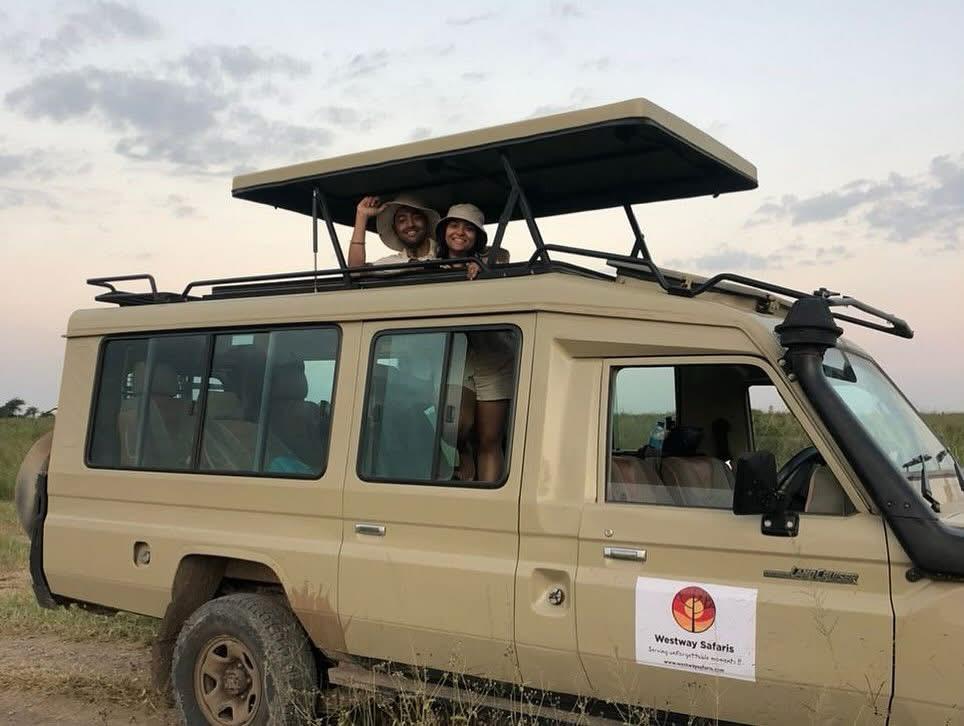
A pop-top Land Cruiser has six window seats and an open roof hatch above them. On a private safari with two or three guests, every person has a window. Every person has roof access at the same time. You spread your camera equipment across the seats without asking permission. You raise your binoculars without bumping an elbow. You whisper to each other when a sighting requires silence. The vehicle is a private room that happens to be in the middle of the Serengeti.
On a group safari with six passengers, the middle seat in each row has a partially obstructed view. If you are the last to book or the least assertive person in the vehicle, you may spend several days on safari in Tanzania with a restricted sightline. The roof hatch is contested space. People are considerate where they can be, but physics are physics. You cannot give six people equal access to a four-window vehicle.
5. Your Itinerary Is Yours
On a private safari, the itinerary begins as a blank page. You tell me your dates, your interests, how many nights you want in each park, whether you want to fly between parks or drive, which accommodation tier fits your budget, whether you have special occasions to mark, and what you have already seen on previous trips. I build the itinerary around those answers. Every element has a reason. Nothing is there because it was on last year's template.
If a guest tells me they have seen the northern Serengeti twice and want something different this time, I redesign the route toward the western corridor or the Ndutu area, depending on the season. If a couple is celebrating an anniversary, I arrange a private dinner outside the tent on night three and a bush breakfast on the last morning. None of this requires approval from five other passengers. It just happens, because the trip belongs to you.
On a group safari, the itinerary is finalised before you book. Your preference to spend an extra night in Tarangire because you have always wanted to photograph its elephants is irrelevant, because the group vehicle is moving to Ngorongoro on day three regardless. You adapt to the schedule, not the other way around.
6. The Pace of the Day Is Yours
A morning game drive on a private safari ends when you are ready for breakfast, not when the lodge stops serving it. An afternoon drive continues until the light fails or you decide to turn back. If you want to stop the vehicle and sit quietly for twenty minutes watching a waterhole without any particular agenda, you stop. If you want to cut a drive short because you are tired or the light is flat and you would rather sit by the camp pool and read, you turn back.
On a group tour, the pace is negotiated among strangers with different energy levels, different interests, different physical conditions, and different ideas about what a good day on safari looks like. Someone will always want more than the schedule allows. Someone will always want less. The guide moderates. The itinerary prevails. Your experience is the average of the group's preferences, not the reflection of your own.
7. The Small Moments Are Protected
Not every significant moment on safari is a predator kill or a river crossing. Some of the moments guests describe to me years later are quieter than that. The morning they drove through mist on the Ngorongoro highlands without speaking. The evening the vehicle stopped on a ridge and they watched an elephant family cross the plains below as the sun went down. A giraffe drinking, which requires it to splay its front legs in a way that looks both ridiculous and elegant, while their daughter laughed until she cried.
Those moments require space. They require a guide who knows when not to speak. They require that no one else in the vehicle is scrolling their phone or sighing or making a remark that breaks the spell. On a private safari, those moments are possible because the environment around them is controlled. On a group safari, you share those moments with strangers, and strangers do not always understand that something is happening that requires quiet.
When a Group Safari Makes Sense
I said I would be honest, and honesty requires this section.
A group safari makes straightforward sense for a solo traveller on a limited budget who is visiting Tanzania for the first time, has flexible expectations about the experience, and is genuinely comfortable sharing a vehicle and schedule with people they have not met. If you are twenty-six, travelling alone, working within a strict budget, and you simply want to see the Serengeti and the Ngorongoro Crater without spending $3,000 per person, a reputable small group operator can get you there. The parks are extraordinary. You will see wildlife. The experience will not be what a private safari delivers, but it will not be nothing either.
A group safari also makes sense for solo travellers who specifically enjoy the social dimension of shared travel and would find a private safari too quiet. Not everyone wants to sit alone in a vehicle with a guide for six hours a day. Some people genuinely enjoy meeting strangers in this kind of environment and find the group dynamic part of the appeal. I respect that preference. It is simply not the same product.
Solo travellers who book private safaris with me are almost always in one of two categories: those who prioritise photography and need total vehicle control, and those who have specific physical or dietary requirements that a group vehicle cannot easily accommodate. In both cases the private premium is fully justified and I would recommend it without hesitation. For everyone else travelling solo, I am honest about the economics: the per-person cost is higher on a private safari, and the value proposition depends on how much the additional control means to you specifically.
The Cost Difference: What You Are Actually Paying For
A private safari costs more than a group safari because the vehicle and guide cost is shared among fewer people. That is the entire explanation. The park fees are identical. The accommodation is identical if you choose the same lodge. The meals are the same. The difference is the vehicle and the guide, which on a group safari is divided among six to eight passengers and on a private safari is divided among two to four.
For a couple, the per-person premium for a private safari over a comparable group option is typically $200 to $400 per day. On a seven-day safari, that is $1,400 to $2,800 per person in additional cost. That is a real number and I will not pretend otherwise. But measured against the total investment of a Tanzania safari, which for a couple in quality accommodation runs $10,000 to $20,000 or more, the private premium represents a 15 to 20 percent uplift on an experience you have likely been planning for years and may only do once.
The more useful question is not whether private safaris cost more. They do. The question is what that additional money buys. It buys a guide whose full attention is on your experience. It buys a vehicle you control completely. It buys the ability to stay for two and a half hours with a leopard if that is what the morning produces. It buys an itinerary that was designed for you specifically rather than for a demographic average. For couples, families, and anyone travelling at the mid-range tier or above, that is not a marginal improvement over the group alternative. It is a fundamentally different experience.

Families: Private Is Not Optional
I want to address families specifically, because the case for private is even stronger when children are involved.
Children experience safari differently from adults. They tire at different times. They ask questions that a group vehicle cannot pause to answer properly. They get excited about things that adults overlook and lose interest in things that adults find compelling. They need a guide who reads them, adjusts the narrative for their age, and knows when to pull over for a termite mound that a seven-year-old will find more interesting than a distant buffalo herd.
On a group safari, a family with children is a complication for every other passenger. The children are too noisy at the wrong moment, or they ask too many questions, or they want to stop when everyone else wants to keep driving. No one says anything, because people are generally polite, but the tension is there and children feel it. They learn to make themselves smaller. That is not what a first safari should teach a child.
On a private safari, the children are the point. The guide designs the drive around their attention. He stops for the dung beetle because a ten-year-old is fascinated by it. He explains the lion's family structure in terms of who is the dad and who is the older brother. He asks them questions at sunset over juice by the camp fire. I have had guests write to me years after their family safari to tell me that their children still talk about specific moments with the guide. That does not happen in a shared vehicle.
My Position on This
I run private safaris. I will tell you honestly that I believe a private safari is the correct choice for almost every traveller who is spending $3,000 or more per person on a Tanzania trip. At that investment level, you are not buying a budget experience and you should not accept a budget product.
The test I apply is simple. If your answer to any of the following questions is yes, a private safari is the right choice for you: Does timing matter to you? Do you want to control the pace of your game drives? Are you travelling as a couple or a family? Do you have specific interests in photography, birds, or particular species? Have you been on safari before and want a deeper experience this time? Do you find shared vehicles with strangers uncomfortable?
If your answer to all of those questions is no, and your primary consideration is cost, a group safari with a reputable operator is a reasonable starting point. But I would encourage you to look closely at the per-person premium for a private alternative before you decide. For couples in particular, the difference is often smaller than people assume, and the difference in experience is larger than most people expect until they have done both.
Questions I Get Most Often
The per-person premium is typically $200 to $400 per day for a couple compared to a comparable group option. On a seven-day northern circuit safari, that adds $1,400 to $2,800 per person. For a family of four sharing one vehicle, the premium per person is lower, often $100 to $200 per day, because the fixed vehicle cost is shared more efficiently. The premium shrinks further when accommodation is at the luxury tier, where the lodge cost dominates the total and the vehicle cost represents a smaller proportion of the overall spend.
For solo travellers, the economics are more challenging because the full vehicle and guide cost falls on one person. That typically adds $250 to $350 per day compared to a group safari. For solo travellers with specific requirements, particularly photographers and guests with medical or dietary needs that a group vehicle cannot easily accommodate, a private safari is worth every dollar of the premium. For solo travellers who simply want to see Tanzania without those specific needs, I give honest advice: a well-run small group of four to six people is a workable option. I would rather say this clearly than take a booking from someone who would be better served differently.
Every Westway private safari uses a Toyota Land Cruiser 4x4 with a full pop-top roof. The vehicle seats up to six but on a private safari typically carries two to four guests, meaning every person has an unobstructed window and full access to the roof at the same time. Our vehicles are maintained on a strict service schedule and equipped with USB charging, a cooler box, a first aid kit, and a communication radio. We do not use minibuses, shared shuttles, or hired-in vehicles from third parties. The vehicle you travel in is ours, and the guide driving it is our employee.
Completely. The itinerary begins as a blank page and is built entirely around your dates, interests, accommodation preferences, and previous safari experience. Every element has a reason and nothing is there because a template required it. If you want an extra night in Tarangire, we add it. If you want to fly between parks rather than drive, we arrange it. If you want a private dinner under the stars on a specific evening, it happens. The only fixed elements are the ones you choose to fix.