The first thing most travellers ask before they ever send a proper inquiry is straightforward. How much does this actually cost? It is a fair question and it deserves a straight answer. I have planned hundreds of safaris from my office in Arusha, and what holds people back from booking the trip they have been thinking about for years is rarely the price itself. It is the suspicion that the number on the page is hiding more than it shows. So in this guide I am going to walk you through what a Tanzania safari really costs in 2026, what shapes the final figure, and why two quotes that look identical on paper can sit four or five thousand dollars apart.
In broad terms, a private Tanzania safari in 2026 starts from USD 560 per person per day for a well-built mid-range trip, rising to roughly $600 to $1,100 per person per day for a true luxury itinerary, and $1,200 to $2,500 or more per person per day for the ultra-luxury tier. A typical seven-day northern circuit covering Tarangire, the Serengeti, and Ngorongoro lands at $3,000 to $4,800 per person at mid-range, $5,500 to $9,500 per person at luxury, and $11,000 to $20,000 or more per person at ultra-luxury, all on a private basis with two guests sharing a vehicle. Those are real ranges from real itineraries we quote every week, not aspirational marketing figures.
Those numbers mean very little, though, until you understand what sits inside them and what does not. Let me walk you through it the way I would on a phone call.
What Is Included in a Real Tanzania Safari Quote
When we send a quote, the figure you see covers a tightly defined scope. It includes airport pickup and drop-off at Kilimanjaro International Airport or in Arusha, your accommodation on a full-board basis for every night of the trip, all national park and conservation area entry fees, your private Toyota Land Cruiser with a pop-top roof, the fuel for that vehicle across the entire route, a professional English-speaking guide for the whole journey, drinking water in the vehicle each day, and the government taxes and concession fees that the lodges pass through. That is the package a serious operator hands you when they call something all-inclusive, and every line should be visible on the quote rather than buried in a footnote.
What sits outside that package is just as important to understand before you compare numbers. International flights to Kilimanjaro are not included because they vary enormously depending on where you fly from and when you book. Travel insurance is not included, although it is non-negotiable for any safari and we will tell you that on the first call. Your visa on arrival, which is fifty dollars for most nationalities and one hundred for United States passport holders, is paid at immigration. Premium drinks at the camp bar, laundry beyond what the camp offers complimentary, and personal purchases are extra. So are the customary gratuities for your guide and the camp staff, which I will return to honestly below because most websites leave them out. Optional add-ons such as a hot air balloon flight over the Serengeti, a walking safari with a Maasai guide, or a cultural visit to a Datoga village are quoted separately so you can choose what speaks to you rather than paying for things you may not want.
What Actually Moves the Price
The headline range is wide for a reason. A handful of factors push a Tanzania safari quote up or down, sometimes dramatically, and understanding them is the difference between feeling priced out and feeling in control of the trip you want to take.
Season and Timing
Tanzania has a high season, a low season, and a series of shoulder weeks that the brochures rarely advertise. The high season runs from late June through October and again across the Christmas and New Year fortnight. Lodge rates during these windows can sit forty to sixty percent above their low-season counterparts, and the best camps in the Serengeti sell out twelve to eighteen months in advance. The low season is the long rains of April and May, when many properties close entirely, prices drop by as much as half, and the wildlife is still spectacular if you do not mind occasional heavy showers. Between those two extremes you have the shoulder weeks: early June, the last week of October into November, and the first half of December. These are the windows I quietly recommend to guests who want serious value without giving up the experience, because strong wildlife viewing in the Serengeti continues right through them while lodge rates sit twenty to thirty percent below peak.
Lodge Tier
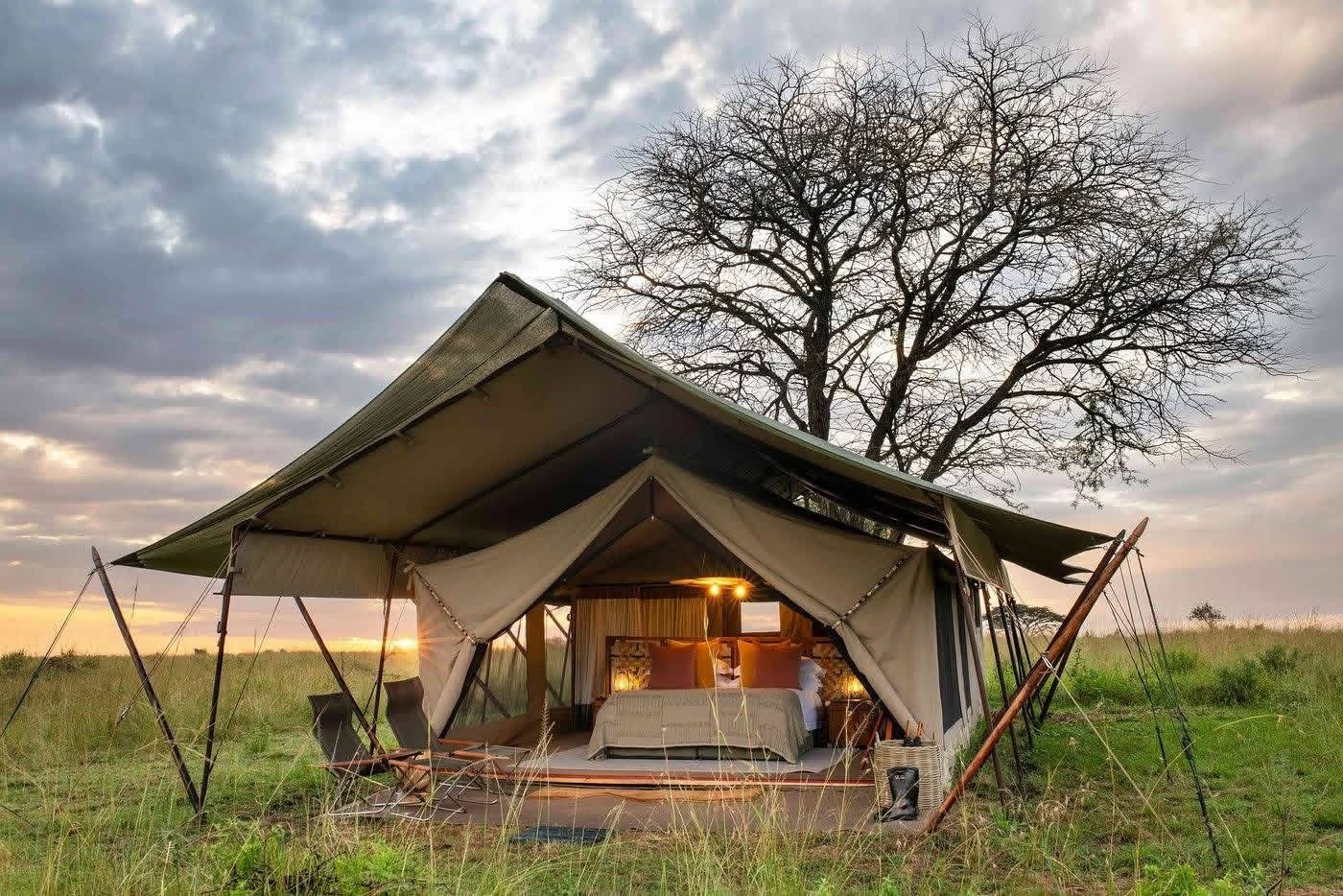
Accommodation is the largest single line on most quotes after park fees, and the spread is enormous. A mid-range tented camp in the central Serengeti runs roughly $350 to $500 per person per night on full board in high season. A luxury property with private verandas and a small tent count sits at $700 to $1,200 per person per night. An ultra-luxury camp such as Singita Sasakwa, Singita Faru Faru, Asilia's Jabali Ridge, Sanctuary Kichakani Serengeti, or Roving Bushtops crosses well past $1,500 per person per night, and a small handful of the truly exclusive properties move beyond $3,000. The same wildlife sits outside every tent. What changes between the tiers is the design, the staff ratio, the food, the wine list, the size of the property, and the sense of intimacy you carry home with you.

Group Size and Whether the Vehicle Is Private
This is the lever guests underestimate most often. A private four-by-four Land Cruiser with a dedicated guide costs roughly $300 to $400 per day in total, and that figure is the same whether one person or six people sit in it. Two travellers sharing the vehicle pay around sixty percent each of what a solo traveller would pay for the same trip. Four travellers pay closer to forty percent each. A shared or scheduled departure, where you join a vehicle with strangers, can shave another twenty to thirty percent off the per-person figure, but you give up the freedom to linger when you find a leopard in a tree, to leave camp at the hour you actually want to, and to slow the day down when something extraordinary unfolds in front of you. I wrote a separate piece on the difference between a private and a shared safari for anyone weighing that trade-off carefully, because it is one of the most consequential decisions in the whole quote.
Trip Length
A safari has fixed costs and variable costs. The airport transfers, the visa, the international flights, and the first day of getting your bearings on the road exist whether you stay four nights or fourteen. Stretch the trip and the per-day cost actually falls a little, because those fixed costs spread across more days. A four-day Tarangire and Ngorongoro loop is the shortest itinerary I will design with a straight face, because anything less feels rushed once you account for the long drive into the parks. Seven days is the sweet spot for most first-time guests. Ten to twelve days lets you add a beach finish on Zanzibar without making the safari portion feel hurried. If you are still weighing the calendar question, I wrote a fuller piece on how many days you actually need for a Tanzania safari that may help you settle on the right shape.
Which Parks You Choose
Park fees in Tanzania are set by the government and they are identical for every operator. Serengeti entry is $82.60 per adult per twenty-four hours, with a separate concession fee of roughly $70.80 charged by most lodges and tented camps inside the park. Ngorongoro entry is $82.60 per person, with a crater service fee of $354 per vehicle on top of that for the descent. Tarangire, Lake Manyara, and Arusha National Park are each $59 per adult per twenty-four hours. Stack those across a typical seven-day northern circuit and you arrive at roughly $550 to $700 per person in park fees alone before a single bed-night is added. The southern circuit, covering Ruaha and Nyerere National Park, is quieter and the fee structure is similar, but the flights between Arusha and the south push the total a few hundred dollars higher. Adding the western Serengeti or Mahale's chimpanzees pushes it higher again.
Realistic Price Ranges by Tier
Mid-Range
A mid-range Tanzania safari in 2026 starts from USD 560 per person per day on a private basis. For a couple, a seven-day northern circuit at this level runs $7,840 to $9,000 total, which works out to $3,920 to $4,500 per person. You stay in well-appointed tented camps and lodges with en-suite bathrooms, hot water, generators that run reliable lighting, full-board meals that are honest and well prepared rather than gourmet, and locations that put you genuinely close to the wildlife. This tier is not basic. It is the level where most first-time guests get more than they expected and feel they have spent their money well.
Luxury
Luxury sits at $600 to $1,100 per person per day. A couple on the same seven-day northern circuit invests $11,000 to $18,000 in total, or $5,500 to $9,000 per person. Tented camps at this tier have ten or twelve tents at most, dedicated butler service, polished glassware on the dinner table, gourmet cooking with a thoughtful wine pairing, private verandas, and locations chosen because the wildlife passes through camp at first light. The vehicle is typically yours alone with a senior guide who has been with the company for a decade. You feel the difference from the moment you arrive.
Ultra-Luxury
Ultra-luxury begins at roughly $1,200 per person per day and runs to $2,500 and beyond. A couple at this tier invests $22,000 to $45,000 or more for a seven-day northern circuit, and considerably more if Singita Grumeti or a private mobile camp following the migration is part of the plan. The properties that operate at this level, including Singita's portfolio, &Beyond's Serengeti Under Canvas, Asilia's flagships, and a handful of private mobile camps, design every element of your time on the property around you. A private chef. A spa treatment under an acacia tree. A four-vehicle private wing reserved only for your party. A guide whose first language is the bush. If this is the trip you have been quietly planning for fifteen years, this is the tier where every moment matches the weight of what it cost you to get there. For some travellers the gap from luxury to ultra-luxury is justified by exactly that. For others it is not, and I tell people honestly when I think they will be just as happy at a slightly lower tier. There is a fuller conversation about that question in my piece on whether a luxury safari in Tanzania is worth it.
Why Two Quotes for the Same Safari Can Differ by Thousands
This is the conversation I most want you to read before you sign anything. Two operators can send you a quote for what looks like an identical itinerary, and the figures can sit four or five thousand dollars apart. The cheaper quote is rarely a gift. It is almost always a different trip wearing the same name.
The most common gap is the lodge category. A cheap quote routinely substitutes a roadside lodge an hour from the park gate for a tented camp inside the park boundary. You lose two of the best game-viewing hours of the day to driving, and the property the cheap quote books is rarely the property the brochure photographs. The second gap is the vehicle. A serious operator runs late-model Toyota Land Cruisers with pop-top roofs, charging ports, cooler boxes, and tyres that will survive the corrugations between Naabi and Seronera. The discount operator runs older minibuses with a single hatch in the roof, and you feel every kilometre of it across a seven-hour transfer day.
Park fees and concession fees are the next place numbers quietly get hidden. Many cheap quotes either bury the concession fee or simply leave it out, and you discover the gap when you reach the gate. Some operators quote without the Ngorongoro crater service fee, which is $354 per vehicle on top of the per-person entry. A few do not include the camp gratuities they will then pressure you for in cash on the final morning. I wrote a longer piece on the hidden costs that show up in cheap Tanzania safari quotes because every one of them has cost a traveller real money I would rather they had spent on the trip itself.
The last gap, and the hardest to see in writing, is the guide. The best guides in Tanzania are paid well by the operators that employ them, and those operators charge accordingly. A cheap quote routinely pairs you with a junior driver-guide on their first or second season, and the difference in what you actually see in a day on safari is enormous. A great guide finds you a leopard in a sausage tree at sunset. A weak one drives past it without registering the tail. If you would like the broader picture of how all of these decisions fit together, my full Tanzania safari planning guide walks the whole arc from the first inquiry to the morning you fly home.
If you already have dates in mind or want to know what this costs for your specific trip, send your details on WhatsApp and I will respond with a personalised answer within a few hours.
How to Get More Safari for Your Investment
There are honest ways to bring the figure down without losing the experience. Travelling in early June or November sits within the strongest wildlife windows and lands you twenty to thirty percent below peak lodge rates. Booking directly with a licensed operator in Arusha rather than through an international agent or an online aggregator removes a markup of twenty to forty percent that you will never see itemised on a foreign-agency quote. Travelling as a couple or a foursome rather than alone uses the fixed cost of the vehicle to your advantage. Mixing a mid-range night in Tarangire with a luxury stretch in the Serengeti gives you the standout moments where they matter most while keeping the overall investment sensible.
One thing I quietly steer people away from is shortening the trip to save money. The fixed costs of flying to Tanzania and getting into the parks remain whether you stay four nights or nine. Cutting two days off the safari rarely saves what guests hope it will, and it often costs you the day in the Serengeti where the trip was meant to come together. A better lever is the accommodation mix or the season, almost never the number of nights on the ground.
Sample Investment Levels for Common Itineraries
A four-day Tarangire and Ngorongoro loop at mid-range sits at roughly $2,240 to $3,000 per person for a couple sharing a vehicle. This is the shortest itinerary I will design without reservation, and it works well for travellers combining a safari with Kilimanjaro or with a few days on Zanzibar.
A seven-day northern circuit covering Tarangire, the central or southern Serengeti, and Ngorongoro is the most-requested trip I quote, and the honest spread is $3,920 to $4,800 per person at mid-range, $5,500 to $9,500 per person at luxury, and $11,000 to $20,000 per person at ultra-luxury, all on a private basis with two guests sharing. You can see this trip laid out day by day on my 7 day private Tanzania safari.
A ten-day northern circuit with a Zanzibar beach finish sits at $5,600 to $7,500 per person at mid-range and $9,000 to $15,000 per person at luxury. This is the itinerary I quote most often to honeymooners and to couples who have set this aside as a milestone trip, and it is the shape behind my 10 day East Africa safari.
A fourteen-day combined northern and southern circuit, or a northern circuit timed to the migration's river crossings with a private mobile camp following the herds, lands at $9,000 to $18,000 per person at luxury and $20,000 to $45,000 per person at ultra-luxury. This is the spectrum where the trip becomes properly bespoke and the figures are built line by line for what each guest actually wants from the days on the ground. For travellers weighing Tanzania against Kenya before committing the investment, my Tanzania versus Kenya safari comparison breaks down the fee gap, the park-fee structures, and where each country actually wins on value.
You see exactly what each line costs and why. If you want to adjust the accommodation tier, swap a lodge, add a night somewhere, we rebuild the numbers in front of you with nothing hidden. That is how we work, and it is the standard I would want for myself if I were the one booking.
Frequently Asked Questions
A private Tanzania safari in 2026 starts from USD 560 per person per day at mid-range, rising to $600 to $1,100 per person per day at luxury, and $1,200 to $2,500 or more per person per day at ultra-luxury. These figures include accommodation on full board, all park and concession fees, a private Land Cruiser, fuel, and a professional guide. International flights, visa, insurance, and tips remain separate.
A serious quote covers airport transfers, accommodation on full board, all national park entry and concession fees, a private 4x4 Land Cruiser with a pop-top roof, all fuel for the route, a professional English-speaking guide, drinking water in the vehicle, and applicable government taxes. International flights, travel insurance, visa on arrival, premium drinks, gratuities, and optional add-ons such as a balloon flight are not included.
The most common gaps are the lodge category (a roadside lodge an hour from the gate versus a tented camp inside the park), the vehicle (a modern Land Cruiser versus an older minibus), park concession and crater service fees that cheap quotes hide, and the seniority of the guide. A cheaper quote is almost always a different trip wearing the same itinerary name.
April and May, during the long rains, carry the lowest rates, often forty to fifty percent below peak, although many camps close. Early June, November, and the first half of December are shoulder windows where lodge rates sit twenty to thirty percent below peak and the wildlife viewing remains genuinely strong. For travellers with flexible dates, these months are where the strongest value sits.
In most cases yes. Booking directly with a licensed Arusha-based operator removes the twenty to forty percent markup added by international agents and online aggregators. You get the same lodges, the same vehicles, the same parks, and a direct line to the person managing your trip. TATO membership and TTB registration are the credentials worth checking.